At my first summer intensive audition, I was doing a développé à la seconde when my supporting leg suddenly felt like jelly. My foot rocked back and forth, I hopped, and my working leg came down.
It was frustrating. I could do a stable développé in normal class! But the cocktail of nerves and excitement had thrown me off. I wasn’t alone, though—auditions can be nerve-racking for even the most seasoned dancers.
Luckily, there are strategies for staying on top of stressful audition moments. Below, two instructors share their advice for combatting nerves, along with some technique reminders for common problem areas throughout class.
Adrenaline Rush
Auditions are tricky because they’re neither a performance nor a regular class, says Natalia Boesch, a New York City–based ballet coach. “They exist in this liminal in-between, where you have a lot more adrenaline than normal, but it’s not a show you’ve rehearsed.” Because of that, dancers are more likely to second-guess themselves, push harder than usual, or hold back.
Anticipating adrenaline ahead of time can help. “Mark with purpose while learning the combination,” says Boesch. “Think: Where am I likely to wobble? How will I combat that?” Then you can focus more on dancing when the time comes. And coordinate your breath with your movement, Boesch adds. Inhaling on retiré and exhaling on développé, for example, can improve stability.

Avoid the Spiral
Jeff Rogers, Ballet West Academy principal faculty member and men’s program director, says the best audition prep is year-round practice. At auditions, dancers should trust their training and commit to each step fully—even with mistakes. He says that “twitch moments,” when dancers second-guess themselves, can cause a self-doubt spiral. “Finish the step, make it look confident, and don’t harp on it,” he says. Successful saves show professionalism.
Technique Tuneup
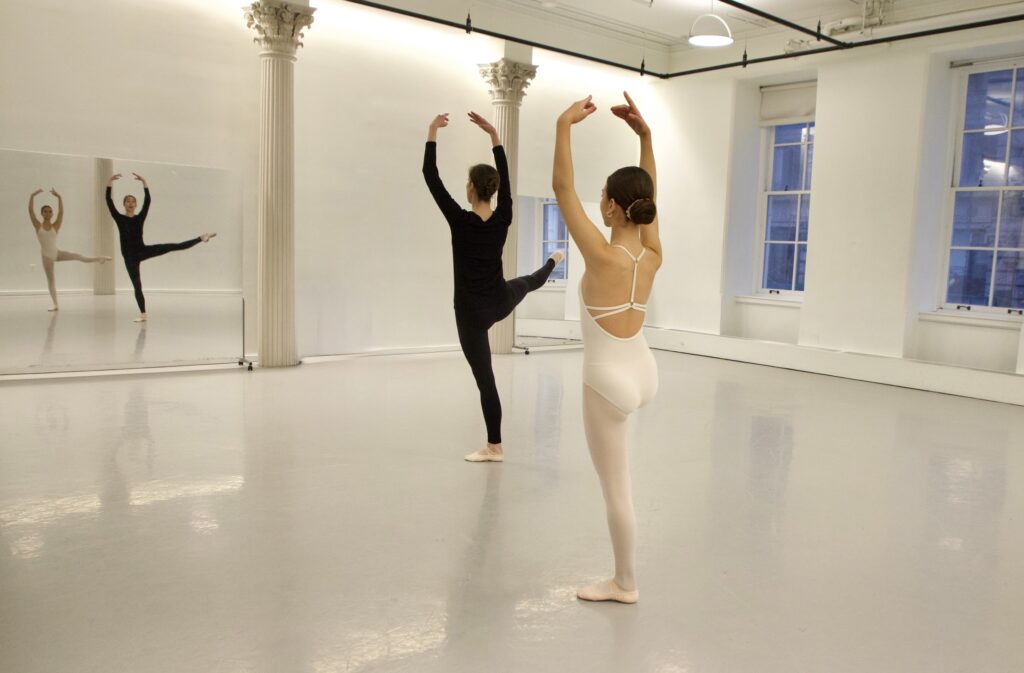
Adagio in Center
Home base: Rogers says that every position moves through “home base”: fifth position. “Even when the leg is up, your legs are still ‘underneath’ you, slightly crossed,” he explains. If you’re feeling unstable, find “fifth” with level, square hips and active rotation.
Hyperextension pitfall: Don’t lock into your standing knee, warns Boesch. “Your hips tip off, and that destabilizes the position.” Activate the glutes and rotator muscles, and center your weight over your metatarsals.
Eyes up: In crowded spaces, lifting your focus creates an illusion of space. That can help you feel more grounded and less claustrophobic, says Boesch, and it helps prevent getting distracted by other dancers—or yourself. “Your own reflection can be a danger zone.”
Stretch: “The higher your leg, the easier it is to balance,” Boesch continues. Improvement is possible in a short time with diligence. She recommends active stretching, especially the lying hamstring stretch with resistance. “Do it twice on each side, twice a day,” she recommends. (But don’t overstretch! Make sure you’re warm and know your limits.)
Pirouettes
Less is more: As a student, Rogers studied with Danish ballet star Erik Bruhn, who emphasized using the minimum amount of effort for the maximum result. Adrenaline can make dancers underestimate their power as they take off for pirouettes, says Rogers, so beware. That can throw off the whole turn.
But go for it: Boesch warns students not to be timid. “The teachers usually don’t know you. If you go for a triple, they may think you do triples all the time, even if you fall out of it.” (Of course, don’t lose sight of technique if you go for more, she says.) Practice some pirouettes in the back to find your center.
Nice save: Practice rescuing your turns. If you’re off-balance, try to find your center again. And always finish with conviction, says Boesch. “Saving the turn is almost more impressive than nailing it.”
Turn it out: Boesch often sees nervous dancers forget to turn out the standing leg, which throws them off balance. Keep the rotation active in both legs the whole way through the turn.

Petit Allégro
Right on time: Before the combo starts, don’t anticipate by shifting your weight. “When that happens, you’re traveling away from the back leg, so you can’t jump from it,” says Boesch. “Everything starts off-kilter, and it sacrifices turnout.”
Beware “emotional tushy”: When anxious, dancers tend to tip the pelvis forward, especially in plié. Boesch’s colleague Deborah Wingert calls the move “emotional tushy,” and it can happen at any point in class. It limits rotation, which can throw off your allégro. Place your hips on top of your feet and maintain turnout, with your pelvis pulled upright.
Beat it: Rogers was trained in the Bournonville style, which teaches dancers to beat on the ascent to make room for a secure landing position. “Keep your plié elastic and hold your core so you can move freely,” he says. Jump high enough to give yourself time, and beat your entire leg—top to bottom, says Boesch.
I’ve got rhythm: For Rogers, rhythm is critical. “Lock it in as soon as possible,” he says. Staying on the beat, with accents, helps you find time to breathe and plié.
Fouettés and à la Seconde Turns
Practice: Unlike most parts of an audition, says Boesch, you can drill coda turns in the way they’re given—starting from a pirouette in center, or in a combination with piqué turns. “Practice as much as you can after class, all year,” she says. “Build up your dizziness stamina.”
Control momentum: “When you lose control of the fondu on the supporting leg, you start drifting,” says Rogers. “Your center has to stay in that fifth-position home base.” For à la seconde turns, he says to visualize a hammer throw (the working leg is the hammer) to understand how important it is to maintain control of momentum.

Keep trying: If you fall out, don’t walk away, says Boesch. Shake it off and try again for the rest of the music. Remember that coda turns are often used for level placement, not as a litmus test for getting in.
Stay aware: If you travel toward someone, stop. “Be respectful,” says Boesch. “Move back to your spot, and try again.” If someone is traveling toward you, fight to keep going. “Whatever happens, don’t let it bring you down.”
Tour en l’Air
Be Prepared: Tour combos are very similar, so practice. “What happens before or after might change, but the tour itself will probably come from a sous-sus,” says Boesch. “Work on salvaging whatever happens.”
Less is (still) more: Beware sloppiness at the end of class. Concentrate on efficiency, says Rogers. “Complete your second spot and don’t drop your back.” Avoid the urge to throw the arms for momentum.
Strong start: Tours begin in fifth-position plié, continues Rogers. “Use your rotation for power.” As you lift off the ground, your back should flip to the front first. “Picture yourself in a glass tube,” he suggests, “reaching your toes to the floor and the top of your head to the ceiling.”
Stick it: “If you finish well, it looks better,” says Rogers. “Even if it was rough.” Remember that people often recognize “off days.” Your performance throughout the entire class is what matters.
The post How to Handle Stressful Audition Moments, From Adagio to Fouettés appeared first on Pointe Magazine.