Summer intensive auditions are the perfect chance to showcase your dance skills—but there’s so much more that goes into making a good impression. While a school’s evaluators look at your technique and potential, they’re also observing how you conduct yourself. Understanding studio etiquette—sharing space, staying focused, respecting your peers and instructors—not only makes the experience better for everyone, it shows you have the maturity to handle a multi-week program.
Here are some basic pointers to keep in mind on audition day.
Check-In Like a Pro
The check-in process is often the first place to make an impression. Arrive on time, and come prepared with any required audition materials, like photos. Being organized and punctual will help the process go more smoothly for everyone.
Rina Kirshner, vice president of A.S.E. Global Bridges, which implements the John Cranko School Summer Intensive in New York and Connecticut, encourages students to check in and retrieve their numbers themselves, instead of their parents doing it for them. “We welcome when dancers ask us questions about the program and engage with us directly,” Kirshner says. “It shows that they’re mature, independent, and interested.”
Turn Off Your Phone
Most schools will insist that smartphones be put away during auditions. But remember to also turn it off. “We don’t want to hear ringing near the doorway,” says Christopher Alloways-Ramsey, director of education at Orlando Ballet School, adding that it’s distracting for both the teacher and other dancers.
[blur-below]
Avoid Clutter
The studio will likely be crowded, so keep your dance bag and personal belongings out of the way or with your parents outside the studio. Shoes, warm-ups, and other supplies spilling onto the floor will potentially get in the way of other dancers. A small bag with essentials, such as a water bottle and pair of pointe shoes, at your barre spot is okay, says Kirshner.
Dress for Success
Adhere to any audition-day dress-code requests. If there isn’t one, aim for simplicity: a solid-colored leotard or, for boys, black or gray tights and a white T-shirt. “We want to be able to easily see the lines of the body,” says Alloways-Ramsey. “If there’s big spangles and bright splashes, it’s harder to see them, but it also generally means the dancer may not be coming from a classical place of training.”
Check your tights for any runs beforehand, and don’t forget to pack your ballet slippers and pointe shoes.
Maintain Spatial Awareness
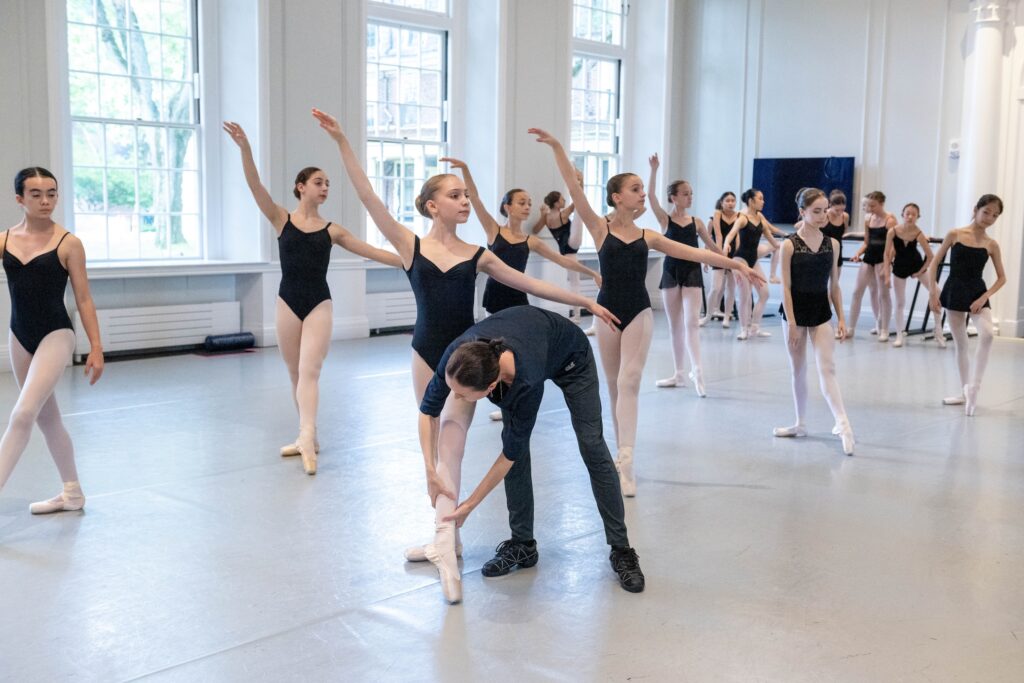
Be mindful of how close you are to other dancers, Alloways-Ramsey continues; space yourself equidistantly from your neighbors at barre and in center. (That means you may need to angle into or away from the barre to avoid accidentally kicking them.)
Stay in numerical order, too. This helps the teachers stay organized as they evaluate dancers. “When we do auditions here in Orlando, we’ll have up to 60 kids,” says Alloways-Ramsey. “We rotate out lines and do tiny groups multiple times if required. Everyone deserves to be seen.”

Respect Others
Most importantly, treat the teacher and your fellow auditionees with respect. Zoning out, picking at your nails, yawning, or casually leaning against the barres while the instructor gives combinations signals that you’re bored or uninterested. “Every moment a teacher is demonstrating is a learning opportunity, and if you really want to be in a rigorous program and progress, we need to see that you’re focused and engaged,” says Kirshner.
Execute combinations as given, too; avoid adding relevés, beats, or turns if they weren’t requested. “Sure, you can add a pirouette if there’s music for it,” says Alloways-Ramsey. “But trying to impress by adding difficulty isn’t really great practice. You want to show off how strong you are from a basic, foundational perspective.”
When your group finishes, quietly wait on the sides so as not to distract others. “It’s not the time to talk to other students,” says Kirshner. “On the contrary, keep marking, or at least look like you’re engaged. Someone may be watching and evaluating you even during your downtime.”
Clamoring to place yourself front and center for each combination, or dancing full-out in the back when it’s not your turn, shows eagerness but can actually be off-putting. “That kind of behavior is very noticeable,” says Kirshner. “Stand out when it’s your moment to shine. But all other times support your peers and be respectful of them.”
Ask Questions If Necessary
Both Kirshner and Alloways-Ramsey say that it’s okay to ask a question if you’re unclear about a combination—just raise your hand. Too many questions can be disruptive, though. Save any inquiries about the program itself for before or after the audition class.
Be Self-Aware
Sometimes young dancers aren’t conscious of certain behaviors, like a sullen expression, crossed arms, or rolling eyes. “I’ve learned that 99 percent of the time that’s frustration they’re directing toward themselves, not the teacher,” says Alloways-Ramsey. “But how that reads to others can set the tone of the class.” The same goes for constantly side-glancing the mirror or the instructor during combinations. Before audition day, check in with yourself at your home studio for any reactions you may not realize you’re doing.
If you’re shy or more introverted, a smiley, engaged expression may not come naturally. Leaning into ballet’s physicality can help. “Classical training has so many minute details—coordinating the head, the eyes, the shape of the face—that can convey a lot of emotion,” says Alloways-Ramsey. “When I was younger, those things helped break me out of my shell.”
Of course, an audition setting can exacerbate nerves. “Just do the best you can,” says Kirshner. “Someone next to you may have great technique, but you can demonstrate your love of ballet, or your musicality. There are different ways to show that you care and are ready to work hard.”
The post Audition Etiquette: 8 Reminders for the Big Day appeared first on Pointe Magazine.