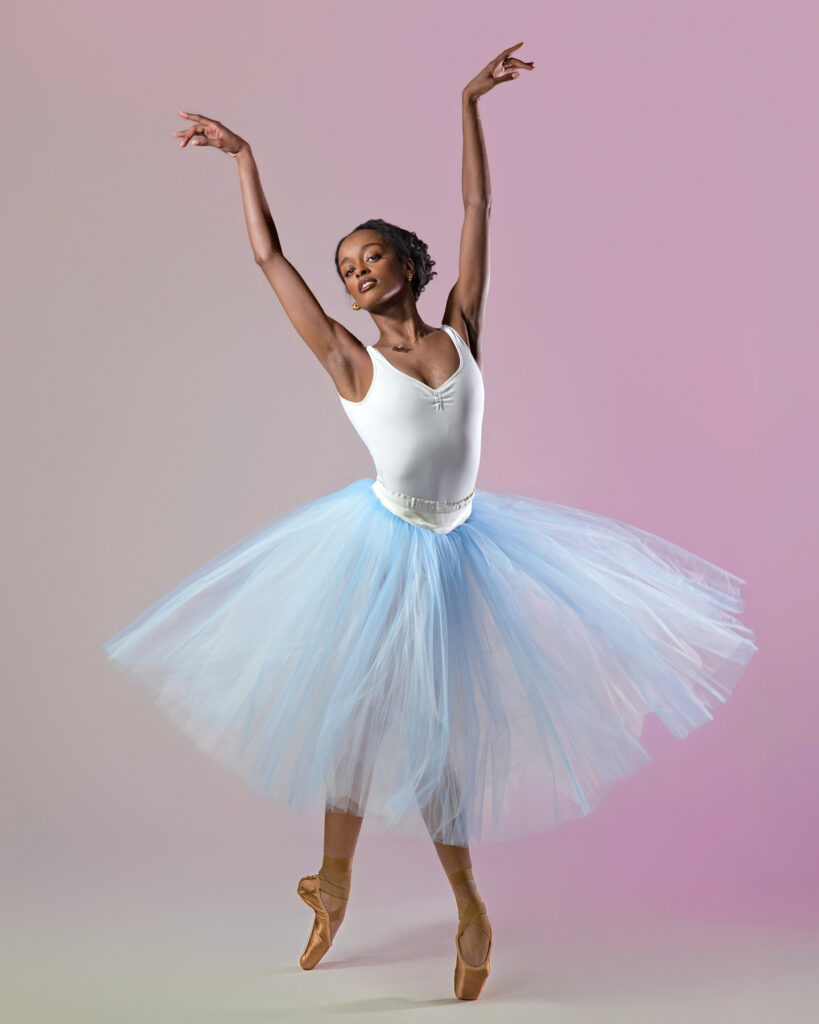
As a newly minted soloist at New York City Ballet, India Bradley now routinely performs featured roles. But even when she was an apprentice—dancing not, say, Dewdrop, but in the back of the flower corps—your eyes would follow her everywhere. Bradley grabs parts big and small with both hands, filling them to bursting with energy and personality. The actual spotlight, now that it’s arrived, almost feels redundant. Who would look away?
As the company’s first Black female soloist, the 27-year-old is also a trailblazer, a role that comes with intense pressure and scrutiny. Privately, Bradley is still adjusting to the glare of this different kind of spotlight. “Only recently have I come to a point where I feel like all the noise around me and my race has started to fade,” she says, “and it’s just my own voice in my head, instead of a bunch of other people’s.” But, outwardly, she has navigated both the challenges and the privileges of the position with grace. She has shaken off internet trolls and become a clear and important voice in social justice conversations. And since her promotion, she has been dancing with even more lucidity and conviction—an artist who knows she belongs center stage.
“No Plan B”
Bradley has dance in her blood. Her mother, Judy, was a member of Alvin Ailey American Dance Theater, and baby India grew up tagging along to the classes Judy would teach near their Detroit home. Bradley was clearly interested in dance—but not necessarily ballet. A social butterfly, she had more fun in jazz classes. “They were less regimented, so I felt like I could laugh and talk to my friends, which at that point was definitely my priority,” she says.
Not until she was 13, when she attended Dance Theatre of Harlem’s summer intensive and then entered its year-round training program, did she fall under ballet’s spell. DTH School faculty member Andrea Long, a NYCB alumna, looked at Bradley’s long limbs and luxuriant extensions and saw a Balanchine dancer. “With those legs, that look, she reminded me of Heather Watts—dipped in chocolate,” Long says.
To test her hypothesis, Long took Bradley to see an all-Balanchine NYCB performance: Symphony in C, Symphony in Three Movements, and Agon. The result was clear. “From then on, I knew that was what I had to do,” Bradley says. “There was no plan B.” After extensive preparations with Long—who became a combination of mentor, surrogate mom, and friend—Bradley attended the School of American Ballet’s summer course in 2014. She enrolled as a full- time student that fall, at age 15.
[blur-below]
As she adjusted to the speed and musicality of Balanchine technique, “it was like my brain clicked all the way on for the first time,” Bradley says. Jonathan Stafford, now artistic director of NYCB, was then the professional-placement manager at SAB. “I was immediately taken with the fact that India is purely India, with a very clear personality and presence in the room,” he says. Younger dancers are often tentative or shy, but not Bradley. “From the beginning, she just went for broke,” Stafford says.
An Early Standout
After Bradley earned her apprenticeship in 2017, that go-for-broke quality made her a favorite with choreographers. Once in the corps, she originated roles in ballets by Justin Peck, Andrea Miller, Kyle Abraham, and Tiler Peck. Tiler, who has worked with Bradley on projects both at and outside of NYCB, makes a point of casting her as much as possible. “She’s the most natural mover,” Tiler says. “She understands the music right away. And she’ll really play with me in the studio.”
From the beginning, Bradley was a hungry dancer, always eager for feedback—and always ready to jump in when needed. “There were moments when people would be falling like flies with injuries, and I was just like, ‘I can do it!’ ” she says. “I knew I maybe wasn’t the strongest technician, but I had personality and I had energy and I had willpower. And I think that got me a lot of places.” (Bradley is now a regular at the Vail Dance Festival; she says Watts, the festival’s creative associate, told Bradley she decided to invite her after watching her go full-out during a sleepy Swan Lake corps rehearsal.)
During pandemic shutdowns, Bradley proved she was not only receptive to feedback, she was ready to offer it. Stafford, who was by then leading the company, says she became an invaluable adviser during discussions about race and equity—instrumental in the company’s switch to flesh-colored tights and pointe shoes, for example. “If there’s something that I need to get an honest opinion on, I know I’ll always get one from India,” Stafford says. “She’s never afraid to tell me the truth.”
Opportunities—and Pressure
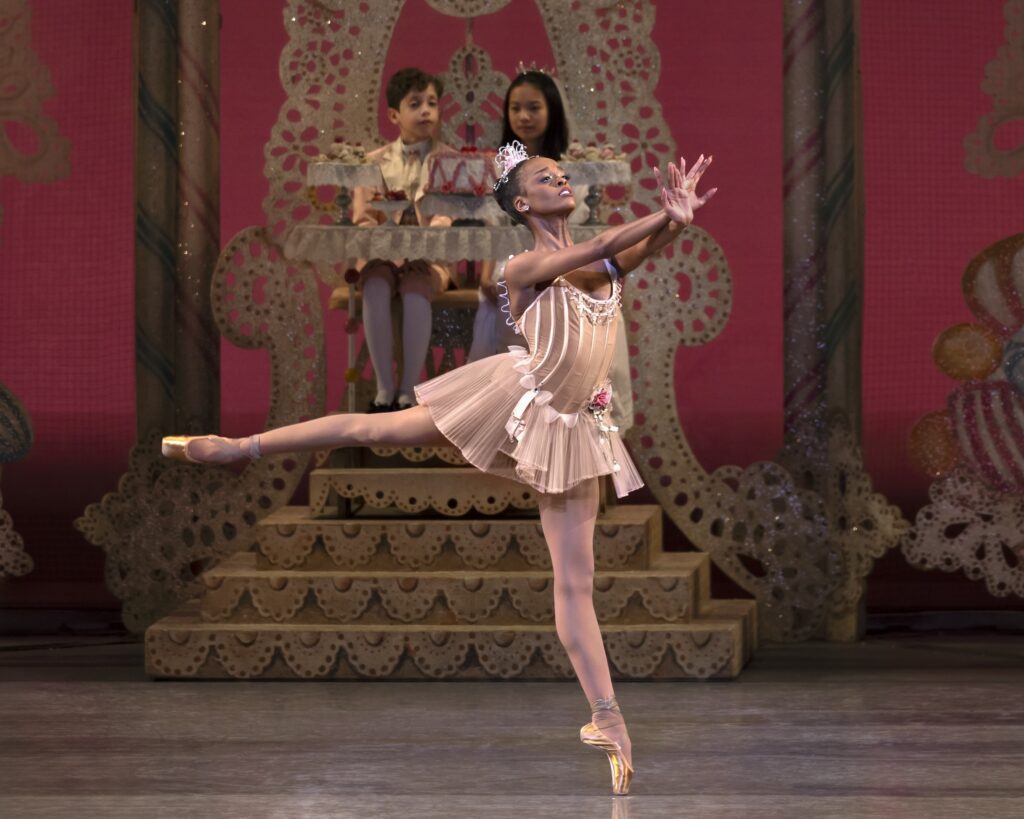
When the company returned to the theater, Bradley began to earn more and larger opportunities. Becoming the company’s first Black Dewdrop in 2023 was thrilling, she says, but also terrifying. The weight of being the first—of being a symbol as well as a dancer making a debut—took its toll. She had stress-induced hair loss before the performance.
“It was all these different spouts of pressure, because the women are rooting for you, and the Black people are rooting for you, and Dance Theatre of Harlem is rooting for you, and New York City Ballet is rooting for you, and maybe some of New York City Ballet isn’t rooting for you,” Bradley remembers. “I was so grateful, but I was also like, ‘I wish I could just worry about the dancing. That’s hard enough!’ ”
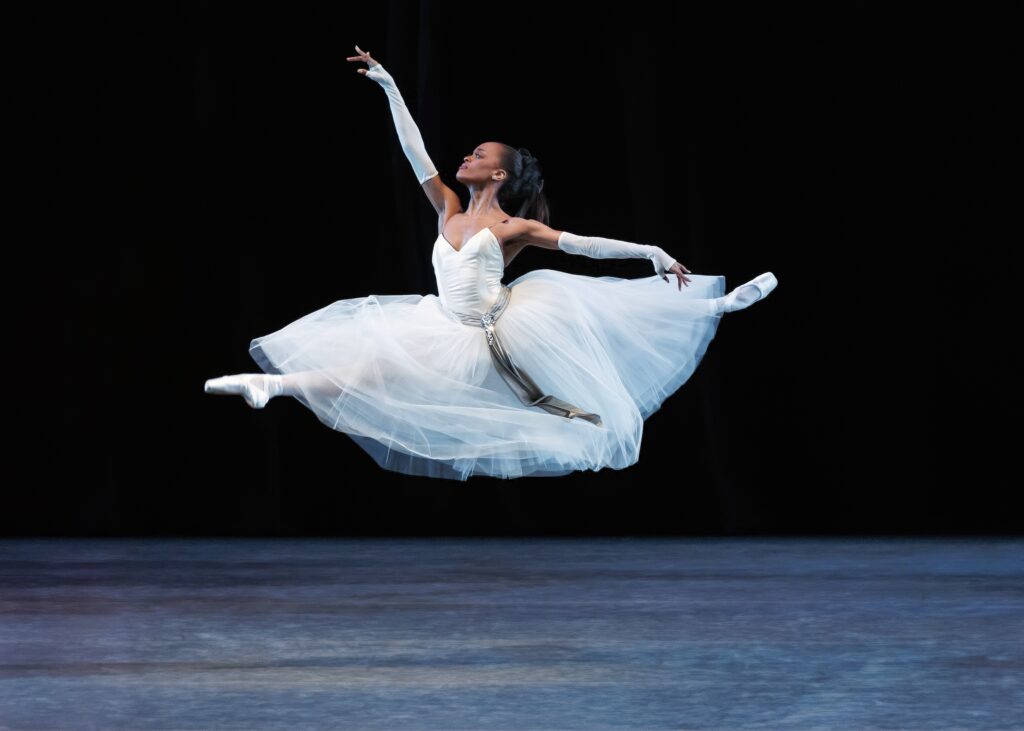
Despite the strain, Bradley delivered a crystalline Dewdrop, an interpretation that’s become both more expansive and more precise as she’s revisited the role over the past two Nutcracker seasons. She had another breakthrough moment last summer, in her heartbreakingly ardent account of La Valse’s doomed maiden—again, the first Black dancer to perform the part at NYCB.
Embracing the Future
Her promotion to soloist in October felt like a puzzle piece snapping into place. “It was this feeling of, ‘Yes, I have worked for this, I have earned this,’ ” Bradley says. “And that’s my way around the conversation of ‘Well, she only got it because of her race.’ I can’t doubt myself when I am 110 percent sure that I’ve done 150 percent of the work.”
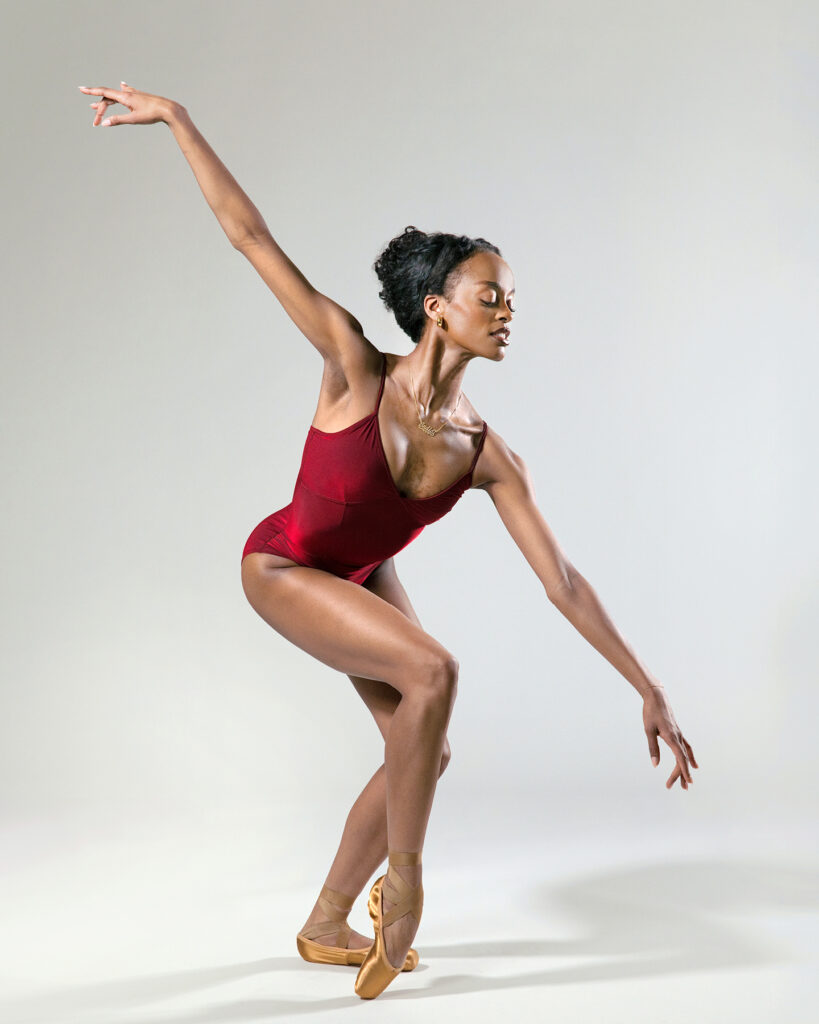
Recently, Bradley has begun to approach her technique more intentionally. “I call myself a late bloomer, because my body is very naturally capable, but I never really knew how I was doing what I was doing—and as you get more roles, that becomes more apparent,” she says. Pilates, Gyrotonic, and physical therapy sessions have helped her learn how to stabilize her core and work around her scoliosis. The difference is visible onstage: Her lines are clearer, her turns more assured.
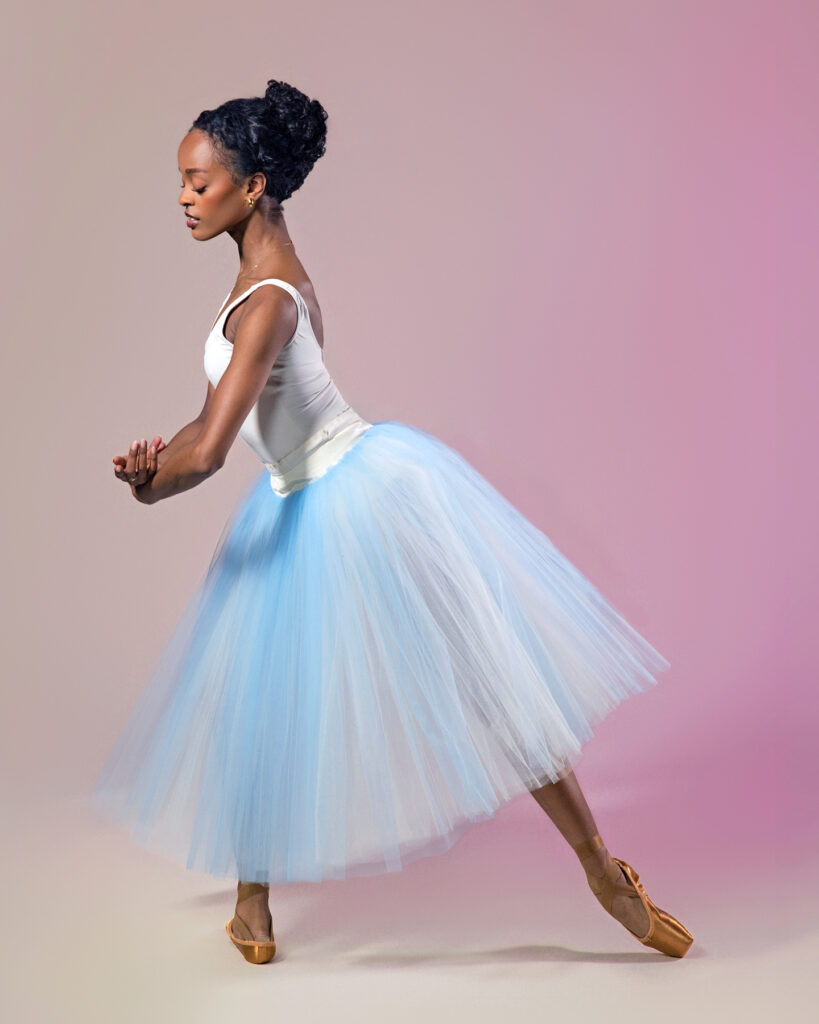
Bradley purposefully seeks happiness offstage, too. Just as outgoing as she was back in her jazz-class days, she reliably gets the rehearsal studio giggling—she can do wickedly good impressions of her fellow dancers—and she organizes regular Sunday-night dinners out with friends. (In her Notes app, she has a long list of restaurants titled “Fun Cocktails.”) She began modeling during the pandemic, and still books modeling jobs when she can. Extremely chic, she’s often Tiler’s sounding board for red carpet looks.
Bradley says her dream roles keep changing over time, as she does. Recently she’s been thinking about Balanchine’s charming, chimerical Duo Concertant. At Vail over the summer, she danced Terpsichore in Balanchine’s Apollo—a very different type of role, at once regal and tender—and found the experience revelatory.
Whatever spotlights might await, Bradley will be ready. “The great thing about growing up,” she says, “is I’m figuring out not just what I like to dance but what I’d like to experience as a dancer.”
The post India Bradley, NYCB’s Sparkly New Soloist, Steps Into the Spotlight appeared first on Pointe Magazine.