Updating a beloved classic while maintaining its integrity is a delicate balancing act. Juliano Nunes, Philadelphia Ballet’s resident choreographer, walks this line with his new Romeo and Juliet. Set to Sergei Prokofiev’s iconic score, the production will premiere on April 30 and runs until May 10 at Philadelphia’s Academy of Music.
Nunes’ Romeo and Juliet doesn’t make any changes to the original Shakespeare tale. “It’s paying respect to where we come from without needing to reinvent the wheel,” he says. But his take on the production zeroes in on the story’s emotionality. “Sometimes we want to ‘over-pretty’ things,” says Nunes. “I’m bringing the raw human reaction.” Passion, aggression, turmoil, and euphoria collide in his retelling as Nunes lets the ballet “surf” between characters’ motives. “It’s a constant [emotional] journey. It’s like a heartbeat,” he says.
To capture that emotion, Nunes’ choreography blends multiple styles, including contemporary and classical. He started with the music to create movement, pulling out rhythms and specific notes. (“Music drives all of my creations,” he says.) His rehearsal process was also collaborative and instinctual, exploring the dancers’ own artistic choices and feelings about the material.
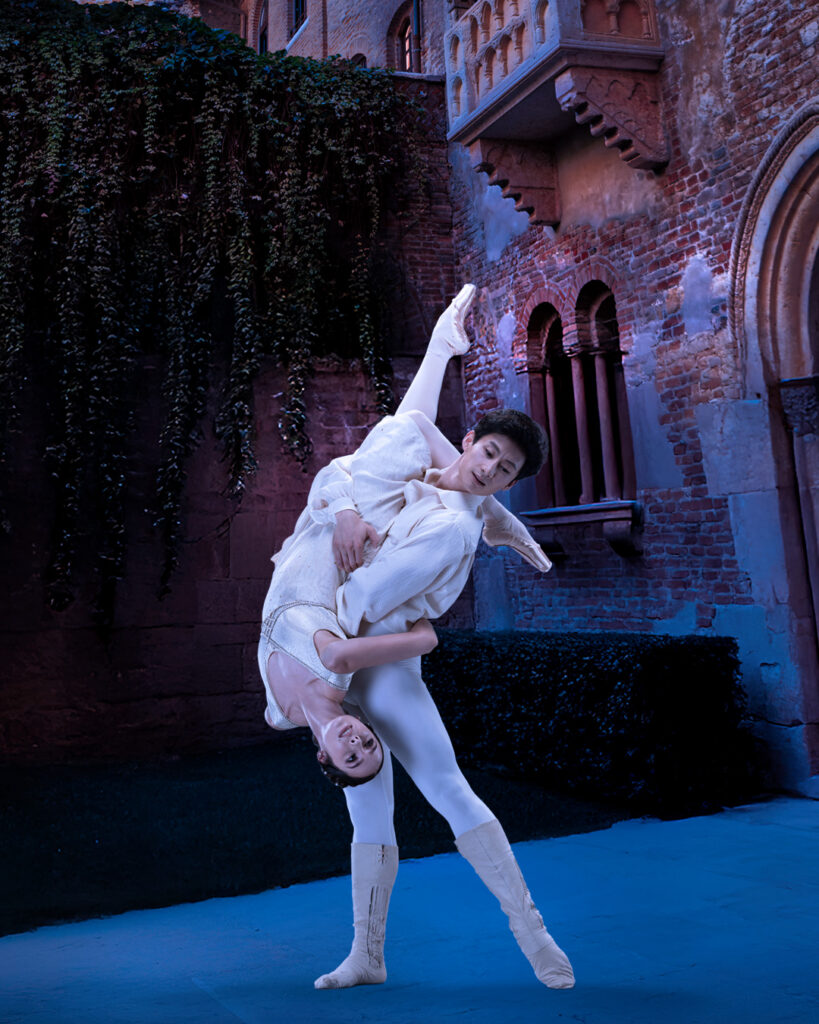
Thays Golz, a principal dancer portraying Juliet, says that Nunes encouraged vulnerability throughout the choreographic process. Golz has tapped into the emotion that drives her role by imagining herself living the narrative. “When you have that dialogue in your head, it just naturally comes out in gestures and body language. It’s not something artificial,” she says.
In the era of short-form video, Nunes says that capturing audience members’ attention spans can be a challenge. To keep viewers engaged, he believes that the entire ballet needs to flow, with each visual and auditory element in harmony: “In order to keep people trapped, you have to trap all their senses.” Nunes’ goal to keep viewers within the story is reflected literally in the set, which features a giant hand-painted book created by costume and set designer Youssef Hotait.
Ultimately, Nunes sees the work as a simple echo of the narrative and Prokofiev’s music. Each viewer is different—people will connect to the story from a different angle based on their background, he says. “If there are many layers, there are parts of it for everyone.”
The post Juliano Nunes’ New <i>Romeo and Juliet</i>, for Philadelphia Ballet, Lets Emotion Lead appeared first on Pointe Magazine.