Athena King has always wanted to earn a college degree. After high school, she enrolled as a dance major at University of Oklahoma. But when Louisville Ballet offered her a Studio Company contract the following year, she took it and transferred to an online program through Central Michigan University, where she’s pursuing a degree part-time in personnel administration. “That’s not exactly what I want to go into,” admits King, who would have preferred arts administration. “But the options for majors were limited, so this was the closest thing.”
Now King has a new possibility: In February, Louisville Ballet launched a partnership with Bellarmine University that allows Studio Company members to earn an undergraduate degree in arts administration within four years, at a 68 percent reduced tuition rate. (The program is also open to full company dancers and staffers.) The university offers flexible course options, as well as internship opportunities, optional on-campus housing, and credit for dance hours logged at Louisville Ballet.
[blur-below]
For King, who is planning to transfer, it’s the best of both worlds. “We get so many performance opportunities here with the ballet, and that’s all going on my resumé,” she says. “At the same time, we can actually get a degree in the allotted time a typical college student would.”
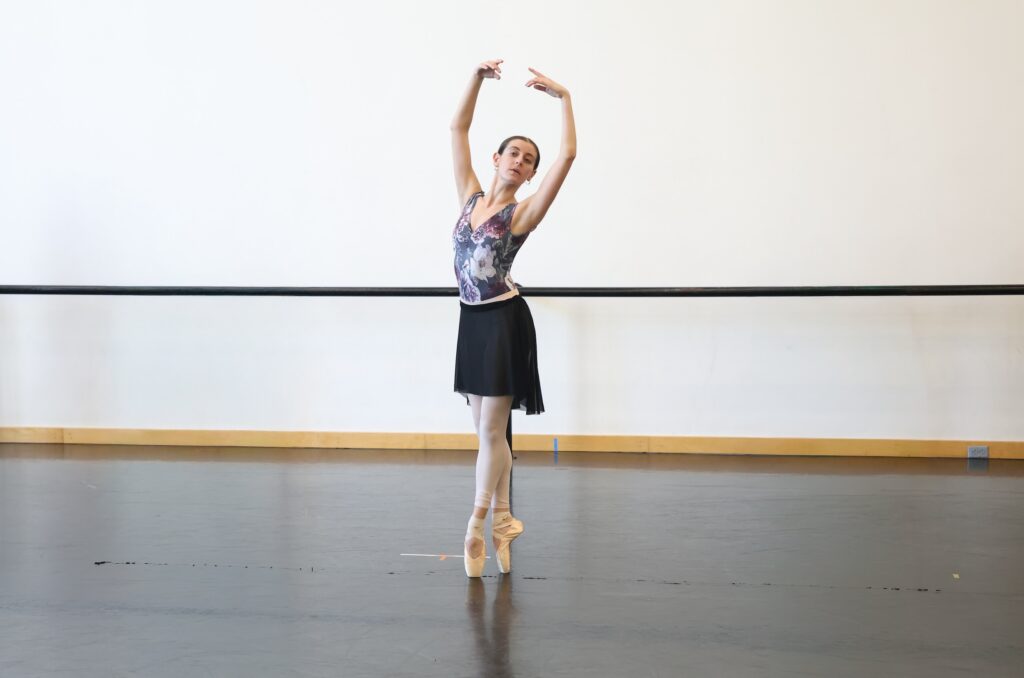
Louisville Ballet isn’t the only company investing in university partnerships—Pacific Northwest Ballet, Boston Ballet, Ballet West Academy, Nashville Ballet, and Ballet Austin Two are a few other examples. These relationships serve a crucial need, as many artists choose to forgo college after high school to seek professional opportunities. But a ballet career is short and risky, and time spent in trainee and second company programs doesn’t always lead to a contract. While many dancers independently pursue higher education part-time, these dedicated partnerships give them a highly tailored and supportive degree pathway.
Opening Doors
Boston Ballet principal Chisako Oga remembers her surprise at seeing fellow dancers studying during lunch breaks when she first joined the company in 2019. “They were all working towards their degrees through Boston Ballet’s partnership with Northeastern University,” she says. “I had always wanted to earn mine but didn’t know how to start.”
The program, open to those who’ve been in the company for at least one year, offers an 80 percent tuition discount to Northeastern’s College of Professional Studies, which caters to nontraditional students. So far, 27 company members—including Oga—have graduated with bachelor’s and master’s degrees since the partnership started in 2013.

Similarly, Nashville Ballet dancer James Lankford says he’s one of approximately 10 dancers currently enrolled at Belmont University through its relationship with the company. The program, which is also open to NB’s second company, trainees, and pre-professional division students, offers an over 60 percent discount on tuition.
Lankford originally wasn’t thinking about applying, fearing school would be too overwhelming with his dance schedule. But when the company awarded him the Patricia Bullard Endowed Scholarship, which allows a principal-level dancer to attend Belmont for free, he changed his mind. “I couldn’t say no,” he says. “I’m very fortunate.” He is currently studying business, with hopes of one day becoming an artistic director.
Catering to Busy Performance Schedules
Flexibility is key to these partnership programs’ appeal. Bellarmine will allow Studio Company members to earn 24 total credits from their daily Louisville Ballet dance classes over the first three years. “I serve as an affiliate [Bellarmine] faculty member, so I’ll teach the classes and grade them,” says Studio Company artistic director Jill Krutzkamp. All of their other credits will be recorded, asynchronous Bellarmine courses that dancers can access at times that fit their schedules. The partnership includes a six-credit internship, which dancers can complete within Louisville Ballet’s various administrative departments or with another arts organization of their choice. “That will give me real, hands-on experience, and I can learn from the people I’ve been working with here every day,” says King.
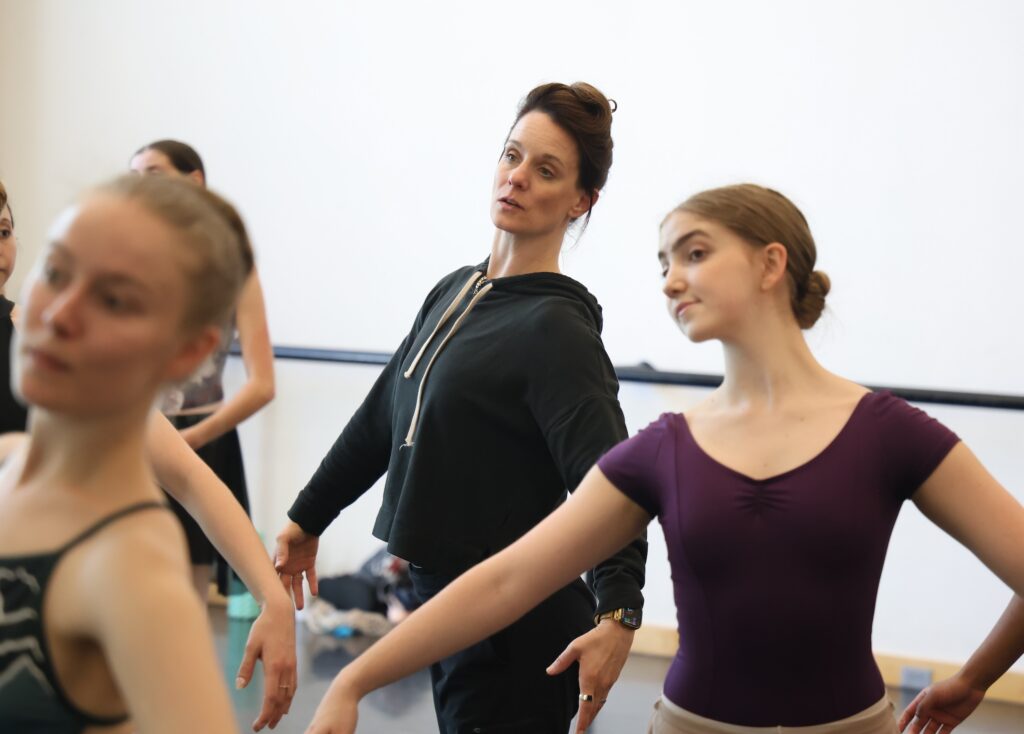
If dancers are promoted into Louisville Ballet during that time, they can still take advantage of the program. Krutzkamp says that a Bellarmine advisor will help keep them on track for their respective degrees, adding that the partnership hopes to offer other majors in the future.
Oga, who graduated with a BS in finance and accounting in 2025, also worked closely with a Northeastern advisor, who meets with dancers at Boston Ballet’s studios about twice a week. Dancers can choose from online, in-person, and hybrid courses. Condensed, half-semester classes (for general education requirements) allowed Oga to take as many as three per semester, in addition to summer courses. “Obviously, there were times of burnout, so some semesters I only took one class.”
Nashville Ballet dancers can choose between in-person and online, asynchronous classes through Belmont’s Adult Degree Program. “I personally prefer asynchronous classes, because I can go at my own pace,” says Lankford, who usually reserves schoolwork for the weekends. He adds that all of his professors are understanding of his dance schedule. “I had to perform at a gala in London last season, and I didn’t have time to write a paper. My professor gave me a very generous extension.” As with Boston’s and Louisville’s programs, a Belmont advisor works closely with the dancers. “She comes in every few weeks and meets with us individually to help us with what credits we need.”
Credit for Career Experience
Lankford is a dance minor as part of his scholarship terms, and he earns credits through his work with Nashville Ballet. And while Louisville Ballet Studio Company dancers also earn college credit for their training, full company members can apply for up to 30 “credits for prior learning” (CPL) for their career experience. “When we told them that, their jaws dropped,” says Krutzkamp.

CPLs, also known as “prior learning assessment” credits, are commonly offered in adult-degree programs and can help expedite graduation timelines. Oga, who graduated from Northeastern in five years, says she was able to put CPLs towards four electives classes. “That was a really helpful perk,” she says.
Security and Support
All three dancers say that working towards a degree—and having their company’s support through the process—has been mentally reassuring. “We only dance for so long, so having this second path gives me a lot of comfort and excitement for the future,” says King.
Oga agrees. “I don’t know how I managed to balance it all, because I was so busy, but I figured it out,” she says. “That confidence boost definitely translated into the studio. We can’t take this job for granted, because at any given moment, something could happen. I’m grateful this partnership allows me to have a backup plan.”
The post Company Partnerships With Universities Give Dancers Flexible Degree Pathways appeared first on Pointe Magazine.