For gymnasts, they’re called “the twisties.” For baseball pitchers and golfers, they’re “the yips.” And figure skating might not have a catchy term, but viewers of the Winter Olympics in Milan Cortina watched skater Ilia Malinin struggle with elements in his routine that normally come easily to him.
This phenomenon—when an athlete chokes under the pressure and is unable to complete skills like they can in practice—can happen to anyone. Dancers may experience it during a competition or an important performance. But why does it happen, and how can you recover if it does? Pointe spoke with a certified mental performance consultant and a ballet coach for their advice.
What’s Going On?
Mental performance consultant Arianna Shimits, MA, CMPC, describes the yips as a task-specific disruption in performance that can involve involuntary movements, loss of fluid motor control, or sudden freezing during well-learned skills. “We can think of it as a response based on a desire to feel mastery over something, paired with thinking about the repercussions of not doing that thing,” Shimits says. The result can manifest as a severe fear response, which can cause a split-second freeze or muscle jerk that interferes with a step’s execution. In dancers, this can look like uncharacteristically falling out of turns or even forgetting choreography.
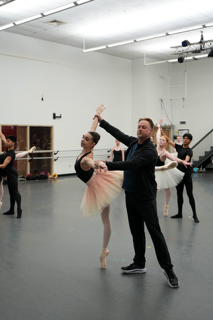
Dmitri Kulev, director of the Nashville Ballet School, recalls a young student he coached for Youth America Grand Prix finals, who suddenly stopped dancing and ran offstage. “He froze because he made one misstep,” Kulev says. “After that, it was like dominoes falling. When one domino is missing, the whole thing stops.” Kulev went backstage to find his student, who was so shocked he couldn’t explain what had happened, only that he wasn’t injured.

While there’s no one cause for the yips, says Shimits, one common denominator is feeling pressure to perform well. “There’s a reason why other fields have a name for this,” she says. “It’s normal to care so much about performing and improving.”
Visualize Success
When Shimits has a client who reports the yips, she teaches them a few strategies to help them work through the mental block. One is visualization and imagery. “This is something a lot of dancers already do,” Shimits says. “How will the floor feel? What will the stage lights feel like?” Often, the dancer will have a hard time visualizing an area of difficulty going well. If this happens, Shimits helps them work through the “sticky” spot by having them watch a video of themselves or another person performing the step correctly, until they can visualize themselves doing it.
Another tool, which might seem counterintuitive, is mental contrasting. Try imagining how it feels for a step or performance to not go well. “We don’t want to hyper-fixate on the mistake or mental block itself,” Shimits says. “We want to think about how we would recover.” For example, if the block is around pirouettes, consider what part of the turn is causing trouble, rather than obsessing over pirouettes in general. The idea is to reassure your body and mind that the step isn’t something to panic over, and that even if it doesn’t go according to plan, you will be okay.
Talk It Out
You can also practice task-focused self-talk, a strategy that Shimits describes as being like reading an instruction manual. For a pirouette, you would internally tell yourself: “Starting with my legs in fourth, I am going to take a nice deep plié. I’m going to bring my right shoulder back. I am going to bring my right foot up to passé, and spot my head around twice.”
“A lot of times what we feel is pure response,” Shimits says. “We are in such an emotional state that we are not experiencing thought. With self-talk, we can come back to the basics in order to navigate through the mental block.” Practicing this can also reveal if you struggle with unhelpful self-talk, a normal but unhelpful habit that can hinder progress. If you notice an inner voice telling you that you can’t do that double tour, try focusing on the mechanics rather than your emotions surrounding them.
When YAGP gave Kulev’s student the opportunity to perform his variation again, Kulev insisted that he take it. The young dancer was able to complete his solo from start to finish.
“It hit me that, when I went back to the studio, I needed to prepare the dancers in a different way,” Kulev says. “There’s always mess-ups. We aren’t programmed like computers.” One change Kulev implemented was giving his dancers more opportunities to perform, so there would be less pressure on a single moment onstage. “When a big mistake happens onstage once, you become a better, more confident dancer,” Kulev says. “You become less scared and more committed.” He also encourages dancers to tap deeper into their artistry in the event of a technical error.
“There’s no set recipe for recovery,” Shimits says. “But blocks aren’t something to be feared. You need to figure out what strategies work for you, gain confidence and competence in them, and work through the block.”
The post Can Dancers Get the Yips? appeared first on Pointe Magazine.