Marie Antoinette (1755–1793), with her sizable wigs, opulent gowns, and untimely demise at the guillotine, is one of history’s most recognizable figures. The Austrian princess, who married France’s future King Louis XVI in May 1770, at age 14, ascended to the throne four years later. Thanks to her Austrian roots and lavish spending habits, she was resented widely by courtiers and commoners alike by the time the French Revolution began in 1789.
Today, Antoinette has become a symbol of luxury and inequity. “When you think about the amount of money that was flowing through that castle to very entitled people, while citizens on the outside were starving, it’s easy to see that happening in our country right now,” says Ballet Austin artistic director Stephen Mills. “There’s nothing more vampiric than the richest person on the planet taking away money from the poorest among us, so to imagine Marie as a vampire felt relatable and current.”

Mills, a longtime Francophile who has visited the Château de Versailles several times, decided to run with that idea. This month, his world premiere Marie Antoinette: Vampire Queen of Versailles will debut March 27–29 at Austin’s Long Center Dell Hall. With music by Graham Reynolds and costumes by Margaret Mitchell, the two-act ballet begins with Antoinette’s marriage to Louis XVI. Suffering under constant public scrutiny, and saddened after seeing a romantic play that contrasts with her own experience of married life, she finds release in an affair with the Swedish count Axel von Fersen. But when she meets a more seductive figure—a vampire, De Maret—she must ultimately choose between love and power. (Or, Mills adds, death and immortality.) Constantly undermined as a woman in politics and eventually faced with the threat of execution, she opts for a life among the undead.
Mills says he has approached the ballet like a theater piece, designing the movement to suit each character’s personality. Louis, for example, has a quirky, foppish manner, whereas Antoinette evolves from a reserved, classical style to a more contemporary one. “There are so many emotional layers simmering,” says Ballet Austin company dancer Grace Morton, who has been cast as Antoinette. “Depending on where she is internally, it shows up in her movement.”
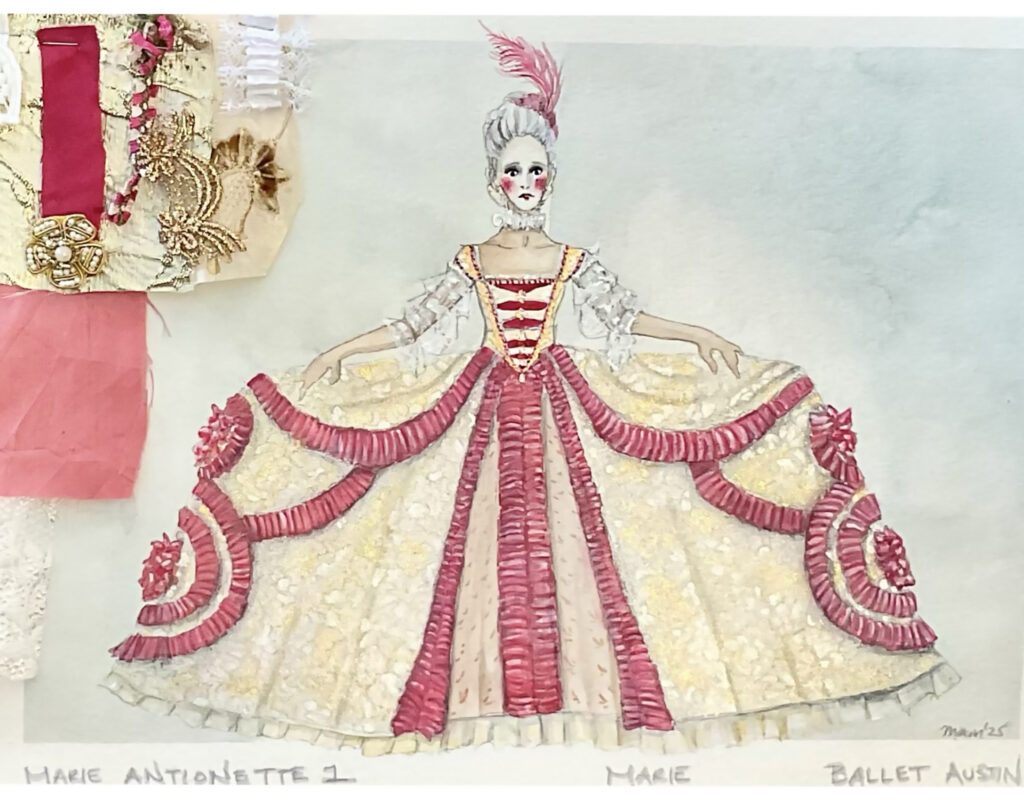

The costumes also reflect the queen’s evolution. Morton describes an early court scene in Act I in which Antoinette appears in a 10-foot-wide hoop skirt, then steps out of it for a Baroque-style dance with Louis. “I see it as a symbol of how glamorous she is, and her indulgent nature,” says Morton. Later, when she meets De Maret in Versailles’ famed Hall of Mirrors, she wears a shorter green dress with silver fragments on the bodice, like broken glass, that symbolize a shattering inside her. Several of Antoinette’s quick costume changes also occur onstage, adds Morton, which allows the audience to see her transformation more tangibly. “She’s onstage for most of the ballet, so it’s an incredibly demanding role. It’s physically exhausting, but in the best way.”
Mills describes the production as a bit tongue-in-cheek. “We’re dealing with vampires,” he says. “It can’t be La Bayadère!” He views vampires as provocative and genderless; their primary motive is to seduce people to surrender their humanity. (He named De Maret after the family name in his own French lineage.) “He really represents the seduction of immortality, untouchability,” Mills explains. That concept is juxtaposed with another character, an undead little girl. “She carries around a little doll whose head is about to fall off,” he continues. “It represents what is about to be the future, which, for Marie in real history, was the guillotine.” But in the ballet, because she chooses life as a vampire—physically placing De Maret’s fangs on her neck at the beginning of Act II—the blade no longer poses a threat. “That’s the twist on the story,” says Morton.
To Mills, Antoinette’s choice mirrors her historical legacy, and it gives her more agency in the narrative. “We don’t really think about Louis XVI, do we? But we sure think about Marie Antoinette,” says Mills. “To me, she’s one of the most immortal characters in history.”
The post Ballet Austin’s <i>Marie Antoinette: Vampire Queen of Versailles</i> Blends History With the Supernatural appeared first on Pointe Magazine.