Over weeks of training in Park City, Utah, far from the sound of ski edges carving snow, three Olympic hopefuls regularly stepped into Ballet West’s dance studio. Elizabeth Lemley, Rell Harwood, and Grace Henderson, freestyle skiers representing Team USA at the 2026 Winter Olympics, are there to work on balance, control, and precision.
Guiding them was former Ballet West first soloist, Allison DeBona, who pushed them to their limits by refining their alignment, strengthening their stabilizing muscles, and sharpening their body awareness to lay the foundation for slick aerial maneuvers and controlled, confident landings.
Our friends at Dance Teacher spoke with DeBona, who is also the principal at Ballet West Academy’s Peggy Bergmann Park City Campus, to learn more about how she created customized training plans and adapted classical ballet techniques to meet the demands of freestyle skiing so Lemley, Harwood, and Henderson could maintain their best performance at the highest level of competitive sport.
When did you first start working with Elizabeth, Rell, and Grace?
It actually was fortuitous because a few years ago, I was teaching beginner baby ballet, and there was a woman—who I knew was a child’s mother—who would sit outside the door and watch every week.
One day, she finally introduced herself saying, “Hi, my name’s Gillian Bower. I’m the director of high performance for the U.S. Ski and Snowboard. I’d love to talk to you about how we can incorporate ballet into training for the athletes.”
It actually took almost a year and a half for things to finally come together. Gillian and I met over coffee, and then I met with some of her trainers for a mock class. I think I won them over because the first thing I noticed right away was that one of the women appeared lopsided when she was standing on two feet. She goes, “You can see that?” I’m like, “Yeah, you’re favoring your left leg, just by standing there.”
Then, last summer, I went in front of basically every trainer that they have up at the facility and taught a full class to all of them and a few of the athletes. It was a long-standing audition process that made me incredibly nervous. But I just jumped right into it.
Last fall, they put together a group of people that they felt really needed that treatment as they were coming off of injuries, which happened to be Elizabeth, Rell, and Grace.
Did any of them have dance backgrounds?
Just Rell. Rell had danced when she was younger in Park City with a different competition school, so she understood the fundamentals of what I was getting at a little quicker. We actually moved a little faster with her. I did a lot of private lessons with her at first, really diving into jumping and being coordinated with jumping. They’re all so incredibly athletic, very coordinated, and so strong.
Was it easy for Grace and Elizabeth to grasp dance concepts too?
They were very smart. They grasped it right away. They actually got better every week, so I knew that they were practicing it because they would come in with a little bit more stability pretty much every week.
What did your training sessions look like?
We weren’t doing [traditional] ballet classes. They were a little bit nervous that I was coming in to teach them ballet, but I was not interested in changing the fundamentals of their sport. I had to actually learn a lot about what they do instead. I was studying videos, watching [skiing] landings. I used a lot of things that I learned returning after having a baby, and how I had to rehabilitate my body, because I was still dancing professionally. My education also goes beyond dancing in the studio and having a professional career. I have a Pilates certification and a college degree, so I studied a lot of pedagogy.
How did you differentiate your training to match the needs of athletes versus dancers?
I realized that [the athletes] were using a lot of their large-muscle groups, so we started focusing on smaller-muscle groups to help sustain and also support the larger-muscle groups. A lot of what we were working on was stability in the knee and ankle, and alignment, so that when they were landing in their boots, there wouldn’t be even a small amount of deviation in their knees and their ankles, which is where they were injuring themselves the most.
I also showed them a pointe shoe, because they understood what it feels like to be bound in a shoe. And we worked on helping them feel the floor with all five toes, because a lot of them are either pronating or they’re out on their pinkie toe, even in their boots.
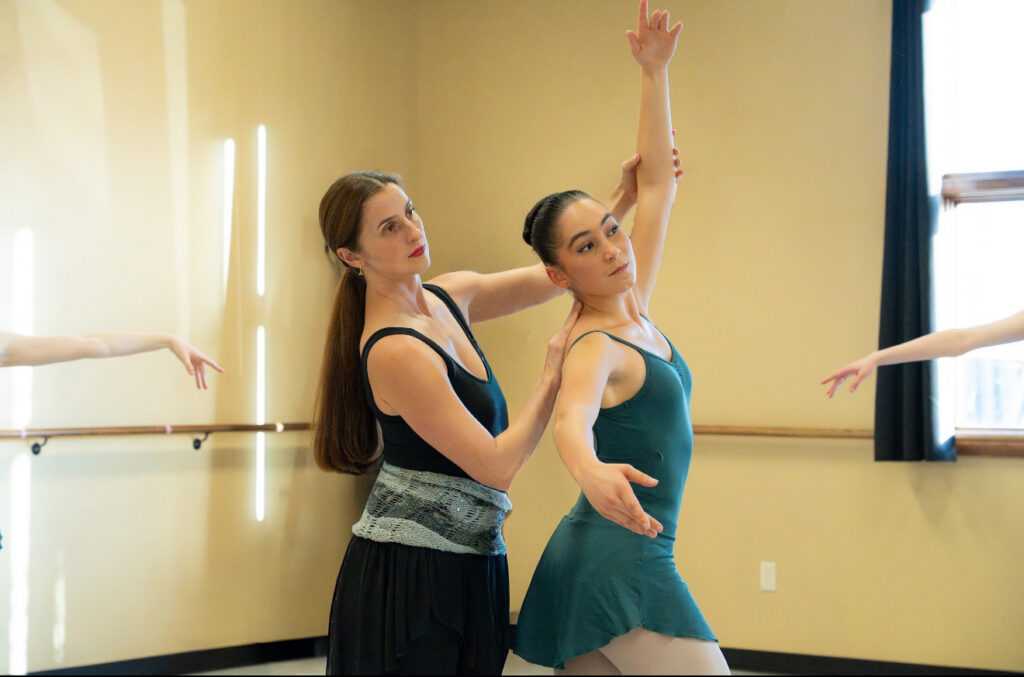
We also worked a lot on one leg at a time to make sure they were controlling their inner thigh, so that their knee stays over their toes when coming back up. They were like, “This is incredible because we wear 50-pound weights on our stomachs and we’re doing all this ab work, and you’re making us do something that seems like no big deal.” But they were dying!
Another thing we talked about is how to warm up their bodies appropriately, how any athlete would. But skiers have to get on a ski lift, and it’s a really long journey, and it’s negative degrees, and then they have to wait their turn. So they weren’t able to stay super warm right before they compete, which could lead to injury. So we put together a warm-up that they could do even in their full gear. Rell actually commented on our social post, saying that she’s still using our workout during her training.
How has working with these elite athletes challenged or expanded your approach as a dance educator?
Honestly, it has not shifted. I feel like my dreams are coming true. The ideology that you have to have a 100 percent capable body for ballet or dance needs to go away, because every other athletic program in the world will tell you that you can still learn how to do things correctly and get there. So why can’t we adjust to facilitate each individual body? You don’t have to have the same correction for 20 people in a room.
What excites you most about seeing your work reflected on the Olympic stage in 2026?
I feel like [these athletes] have worked their entire lives to get there and I can’t say that I’m a huge part of it in any way. It’d be inappropriate to say, “It’s all me.” I’m just honored to be a small part of their journey, and I hope that we, as dance teachers, could become a larger part of many of these athletes’ journeys.
What advice would you give dance teachers interested in working with athletes or non-dancers?
The number one thing is just to respect their sport. I think it would be unwise to go into a training session with another athlete trying to push ballet [or any other form of dance]. The purpose should be: “How can I get you more flexible?” Or “How can I get your knees straighter?” Support their sport and their goals. That’s the best way forward.
Editor’s note: By press time, Elizabeth “Liz” Lemley won the gold medal in women’s freestyle mogul and bronze in the dual-mogul events at the 2026 Winter Olympics; Grace Henderson placed 14th in the big-air qualifying run and 15th in freestyle slopestyle’s qualifying run; and Rell Harwood placed 23rd in the big-air qualifier, but was unable to compete in the women’s freestyle slopestyle due to a knee injury.
The post How Ballet West’s Allison DeBona Coached Team USA’s Olympic Freestyle Skiers appeared first on Pointe Magazine.