This year, The Royal Ballet School is celebrating its 100th anniversary. Founded in 1926 by Dame Ninette de Valois, the school has since grown into a major international ballet academy producing world-class dancers. “When we look at where we started and where we are today, in some ways it’s like night and day,” says Iain Mackay, the school’s current artistic director. “But, actually, the heart and soul of it remains the same. It’s about creating dancers that are going to go on and create relevance for the next generation.”
Mackay, a former principal with Birmingham Royal Ballet and Corella Ballet, and a graduate of The Royal Ballet School’s Upper School, is proud of the school’s history. But he also has the future in mind; since taking the helm in 2024, he’s made swift changes to the school’s training model and introduced new initiatives. “There’s been such a huge shift in dance training and culture, across companies and schools, as well as societal shifts,” says Mackay, who attracted attention in interviews last year after calling for more body diversity in ballet, with less focus on thinness. “My goal is to train healthy, strong dancers with autonomy, who can articulate what they want from their future in dance.”
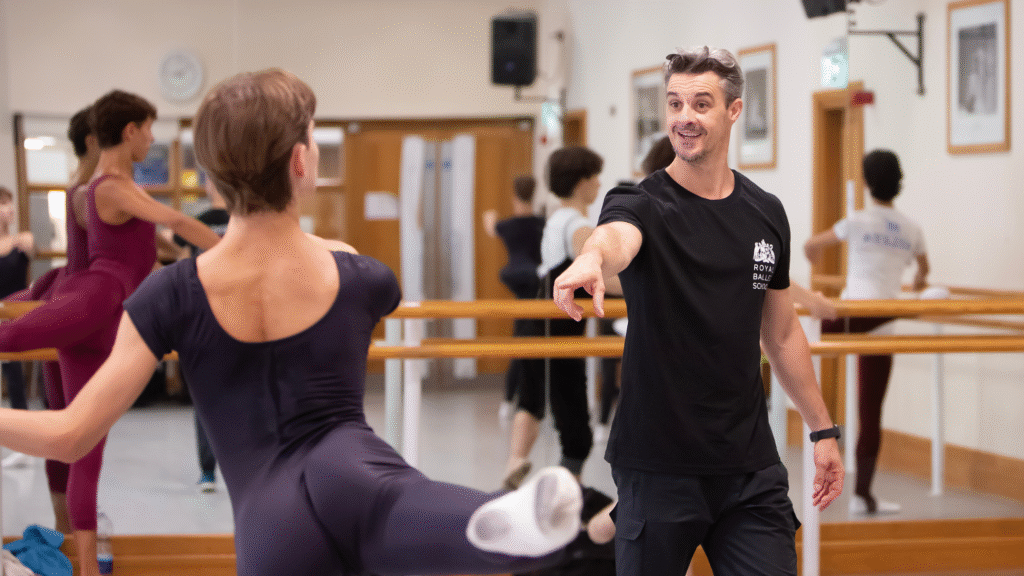
He also wants to create more access, including for American students. This year, The Royal Ballet School is holding a two-week summer intensive in the U.S. for the first time at The Music Center in Los Angeles. Pointe recently caught up with Mackay on Zoom to learn more about the new summer program, as well as the big changes he’s making in London as the school looks ahead.
Adjusting the Training Model and Culture
Mackay stepped into the artistic director role at a time when the school was facing critical scrutiny in the U.K., with a lawsuit from a former student and a BBC Panorama documentary that investigated allegations of body shaming and other abuses at The Royal Ballet School. (The school settled with the dancer, Ellen Elphick, out of court in 2025 without admitting liability.)
“A lot of the changes we’ve made are student-focused,” Mackay says. One of the biggest is adjusting the age at which dancers begin full-time training. Historically, admission to White Lodge, The Royal Ballet School’s vocational boarding school for younger students, started at age 11, or Year 7 according to its syllabus. Starting in September, Year 7 students will instead train through a new U.K. Scholars program alongside the school’s national Mid-Associate Programme, its network of affiliated training centers around the country. This will extend to Year 8 dancers (ages 12 to 13) in 2027. This way, these younger students can continue to live at home and study locally, in anticipation of later full-time vocational training.

Research showing that early specialization does not necessarily predict future outcomes drove the decision, says Mackay. A careful review that included students’ own experiences found that dancers entering full-time training slightly later often showed greater resilience and emotional readiness. “There’s also the element of society not wanting to send their children away to a boarding school environment so young,” says Mackay.
He also did away with a required audition for Year 9 White Lodge students (around age 14) to enter Year 10. “I firmly believe that ballet training is hard enough,” says Mackay. “There’s a mindset and level of confidence that’s involved. These auditions perpetuated anxiety and the fear of ‘I’m gonna get cut.’ If we are selecting students, then we should commit to them the way that they commit to their training, and see that through.” He adds that dancers still need to audition for the Upper School at Covent Garden, for ages 16 to 19, where the level of training ramps up considerably.
The Royal Ballet School Heads to Los Angeles
Mackay says that The Royal Ballet School has always had a large number of American students at its annual summer course in London. “But we can’t always cater to them, especially younger ones,” he says. “Plus, not every parent wants to send their child across the globe for classes.”
Adding a summer program in the U.S. felt like a natural opportunity, Mackay continues. “L.A. seemed like a really great starting point. The Royal Ballet toured to The Music Center not too long ago, and we always get a lot of applications from West Coast students.” The course includes a one-week intensive for dancers ages 10 to 13, and a two-week course for those ages 14 to 19.

Mackay says he’s long admired American dancers, especially their sense of fearlessness. He’s excited to share the Royal Ballet School’s training system with them. “We have a very distinct style, especially with our repertoire and how we teach it.” Six to eight faculty members will offer classes in technique (in ballet and other genres), choreography, conditioning, and repertoire. Students can also sign up for individual coaching sessions, separate from the intensive.
He adds that the L.A. intensive is not a scouting exercise. “It’s an access point, a way of sharing what we do with as many people as possible,” says Mackay. “Of course, if dancers are good and we can create a pathway, we will. But mostly it’s for these young dancers to experience something new, and bring it back to their home studios. Just like I’d love for our students to experience American intensives.”
The post Iain Mackay on Changes at The Royal Ballet School, Plus Its First U.S.-Based Summer Intensive appeared first on Pointe Magazine.